
This project aims to provide an inventory of algae species that can be used in reduction of pollution into Lake Victoria. Lake Victoria's integrity as a source of fish and water for drinking to the ever growing population is challenged by pollution from industries and other human activities. This problem is in turn exacerbated by limited research in alternatives of waste water treatment as the existent technologies are expensive and yet affordable ones are obsolete. This impedes proper industrial and municipal effluent treatment and the end result is increased pollution into Lake Victoria as the major collector of wastewater from major towns in the country. The pollution has eventually led to eutrophication, algal blooms and fish kills. We aim at tapping the potential of these algal bloom species in treating industrial effluent. This project will also dig further into turning the nuisance algae into a fuel treasure contributing to solving energy needs in Uganda.
TLake Victoria, Africa's largest tropical freshwater lake is the largest tropical lake in the world
(68,000 square kilometers), with its waters shared by three countries (Tanzania, 51%; Uganda,
43%; Kenya, 6%). The lake is best known for its more than 300 endemic species of
haplochromine cichlids (Witte et al., 1992) in addition to a rich assemblage of non-cichlids
inhabits (Balirwa et al.,2003; Taabu-Munyaho et al., 2014). Lake Victoria contributes to the
economic growth of the country through contribution to the 3 % GDP from fisheries and is a
source of livelihood to millions of inhabitants in the riparian zone. Lake Victoria, is also
critically an important source of drinking water for the rapidly growing population living (Oguttu
et al., 2008). Evidently, Lake Victoria's services are indispensable and are key to the country's
strategic plans for growth. However, the rapidly growing urban population with its increasing
demand for freshwater resources and the extensive growth of agricultural and industrial activities
have given rise to progressively increasing problems related to the environmental state of Lake
Victoria (Ntiba, Kudoja and Mukasa, 2001). More regrettably, Lake Victoria is the primary
recipient of industrial and municipal waste in Uganda. The impact of pollution on fisheries and
the potential health implications of eating contaminated fish are areas of considerable concern
for the fishing and aquaculture communities, government bodies and the general public. In
addition to over fishing, pollution is contributory to recent serious declines in global fish stocks
(Lawrence and Hemingway, 2003). High nutrient pollution during the past 50 years have
increased eutrophication levels in the lake, particularly in the regions along the lake shore
(Hecky, 1993). The overall phytoplankton biomass has increased with a fourfold and eightfold
increase in the Chlorophyll a (Chl-a) concentrations in the offshore and inshore areas,
respectively. Lake Victoria is regarded as highly eutrophic and blooms of cyanobacteria (bluegreen
algae) have now become common in the lake. Besides being non-palatable to fish,
cyanobacteria blooms are a cause of concern to local water consumers, policy makers, and also
lead to increase in cost of water treatment (Mwe, 2013). In areas, close to urban centers such as
Murchison Bay, dead fish have been observed floating close to the shoreline. In East Africa,
massive fish kills were observed in the Nyanza Gulf of Lake Victoria (Kenya) in 1984,
coinciding with the occurrence of cyanobacteria blooms (Mwe, 2013). Thus, algal blooms are a
serious threat to the Lake Victoria fisheries.
Positively, some species of algae found in these blooms have been reported to be efficient in
removal of different types of pollutants and toxic chemicals such as nitrogen, phosphorous,
potassium, nitrite, silica, iron, magnesium and other chemicals from municipal and industrial
wastewater (Maity et al., 2014). This project aims to investigate the use of the algae species in
algal bloom hotspots in remediation of pollutants in industrial effluent. The capacity of algae
species collected from the lake will be investigated and tested in order to determine the
efficiency of each species in bio-filtration. Studies carried out elsewhere in the world have found
some species (also found in Lake Victoria) such as Chlorella vulgaris (Mwe, 2013) and
Scenedesmus quadricauda (Xin et al., 2010; Shanab, Essa and Shalaby, 2012) efficient in
extraction of nutrients and heavy metals from wastewater. Other studies have involved species
un common to our Ugandan lakes but still provide insight on feasibility of the proposed study
(El-Sheekh et al., 2014; Fawzy and Issa, 2016). A study in Egypt portrayed the capacity of
Anabaena oryzae in reducing nitrates and phosphates by over 80 % in effluent (Fawzy and Issa,
2016). Through such efforts, biological wastewater treatment systems with micro algae have
gained importance in last 50 years and it is now widely accepted that algal wastewater treatment
systems are as effective as conventional treatment systems. Algal wastewaters treatment systems
offer a low-cost alternative to complex expensive treatment systems particularly for purification
of municipal wastewaters. Indeed, such research is still young and this shows that a lot more
needs to be done, given the increasing pollution due to human activities. Research about use of
many species in Lake Victoria, let alone dominant ones among algal blooms such as
Dolichospermum circinale for bio filtration are very scanty.
Since the study involves culturing and propagation of suitable algae species, there will be
excessive algae growth and the study intends to investigate alternative ways of disposal of the
excess algae or sludge. This sludge is potentially valuable biomass, which can be used for
biofuels production and thus contribute to reduction in the energy crisis in our country. With the
current global energy crisis and growing environmental concerns, such as climate change and
pollution of water resources, Uganda has to find alternative and sustainable ways of producing
renewable energy to meet the needs of the growing population (Tumwesigye et al., 2011). As
evidenced in low levels of consumption of modern energy forms (electricity and petroleum
products), the inadequacy and poor quality of electricity services and the dominant reliance on
wood fuel sources, energy poverty exists at all economic levels in Uganda, especially at
household level in rural areas of Uganda. Uganda currently has one of the lowest per capita
electricity consumption in the world with 215 kWh per capita per year (Sub-Saharan Africa's
average: 552 kWh per capita, World average: 2,975 per capita). Moreover, access to electricity is
very low 5.6% in 1991, 9%; in 2006, 10% in 2010 and 15% in 2013 but only 7% on average in
rural areas.
The solution lies in ancient photosynthetic microorganisms (Hannon et al., 2010) that can be
found in almost any aquatic environment today: algae. These rapidly growing micro-organisms
can potentially be employed for the production of algae biofuels in an economically effective and
environmentally sustainable manner.
Water pollution is a global challenge that has increased in both developed and developing countries, undermining economic growth as well as the physical and environmental health of billions of people. Global attention has focused primarily on water quantity, water-use efficiency and allocation issues, whereas poor wastewater management that has created serious waterquality problems in many parts of the world, has been given limited attention (FAO, 2011). In
Uganda, pollution resulting from increased human activities is threatening Lake Victoria, its
effects being characterized by eutrophication and the occurrence of dramatically low dissolved
oxygen levels (Scheren, Zanting and Lemmens, 2000) and algal blooms, together contributing to
decreased fisheries productivity and production. Estimation of pollution loads from different
interventions (LVEMP (1 and 2); Okwerede et al., 2005) show that major threat comes from
urban centers, with a high population of people and industries. Unfortunately, for many
industries, the conventional treatment process is expensive and therefore still utilize inefficient
obsolete technologies. In addition, connection services to the sewer system are expensive and
thus effluent may be released partially or not treated ending up into the lake. Wetland
encroachment is also a strong impediment to tertiary wastewater treatment. Unfortunately, there
are few alternatives to waste water management in Uganda that industries could adopt in order to
manage their waste water. This has been worsened by limited research in Uganda on use of algae
in wastewater management. This project aims to investigate the potential of microalgae for
effluent treatment due to the ability to use inorganic compounds (Nitrogen and Phosphorus) for
their growth. In addition to their low energy requirements, microalgae have been found to be
cost-effective combining different steps of treatment, and produce a sludge (biomass) that can be
valuable in biofuels and food production unlike traditional wastewater treatment facilities, whose
sludge has limited disposal techniques and contains waste material that could cause secondary
water pollution.
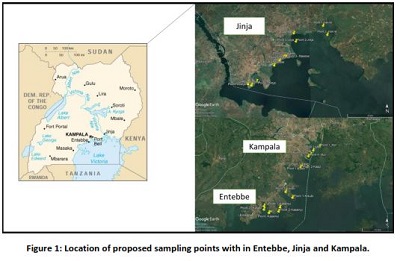
The study will focus on the northern part of Lake Victoria. Sampling will be obtained from areas close to both large and small scale industrial activities.These sites will be selected off Google maps and a reconnaissance survey will be done prior to data collection in order to confirm the selected sites. The predetermined sites are from within Gaba-Nakivubo, Kirinya-Napoleon Gulf and Entebbe area (Figure 1).
The project will be hosted at the National Fisheries Resources Research Institute (NaFIRRI)
under the direct supervision of the Institute Director. NaFIRRI will host the project because of its
proficient technical and administrative infrastructure at Jinja. The headquarters at Jinja has office
space for administration, scientists, and well-furnished laboratory for algae studies. In addition,
there are 2 Aquaria, a Cage culture demonstration site in Napoleon Gulf, Lake Victoria, an
Aquatic Biodiversity Museum, Conference Hall and an Information and Data Centre equipped with over 800 journals subscribed to international electronic databases. The institute is a member of the FAO-based Aquatic Science & Fisheries abstracting services that provides literature in hours.
The principal investigator (PI) will be responsible for the day to day project coordination. Project activities will be jointly implemented by the team members from the partner institutions on a Loss of livelihoods Limited knowledge to handling waste quarterly basis guided by the Quarterly work plans and Budgets. Activity reports will be submitted within five days after completion of the activity while detailed Quarterly and Annual progress reports shall be prepared and submitted one week after end of every quarter and year respectively. The PI shall organize joint annual meetings to review project progress. In addition, a multi-stakeholders' sensitization platform will be organized after every project year to engage beneficiary partners in the project findings and the next steps to be taken.
In ensuring adherence to accountability guidelines, the NARO wide internal financial controls and guidelines will apply throughout project implementation. No new activity shall proceed without submission of satisfactory technical and financial accountability of the previous activity. The project will benefit from National Research Laboratories at Kawanda for genotyping of thealgae prior to culturing during the second year of implementation
Water samples will be collected from predetermined areas infested with algal blooms. The
micro-algae will first be identified morphologically under an inverted microscope sedimentation
technique using (Utermöhl, 1931), to determine the dominant algae species.
Algae enumeration
will be done under an inverted microscope and identification made with the help of standard
literature (Komarek and Anagnostidis, 1999; John, Whitton and Brook, 2000)
In addition, to understand the habitat conditions of the species, water physical parameters of each
site (temperature (o C), dissolved oxygen (mgl-1), pH, and conductivity (µs.cm) will be
measured in-situ using portable metres at geo-referenced sites. Concentrations of macronutrients
(Total Nitrogen (TN), Total Phosphorus (TP) and Silicon (Si) that drive primary production will
be determined at 2-m intervals from surface to bottom by collection of samples with a standard
van Dorn water sampler and stored in a cooler for laboratory analysis. TN (µgl)will be analyzed spectrophotometrically (APHA, 1999). Chlorophyll a (Chl-a) concentration will also be determined after sample extraction in 90% methanol.
The predetermined dominant species will be isolated out in the sample by streaking as described
in Singh et al. (2015) to make single species culture using different media. These pure species
will later be propagated or precultured in enclosed facilities in an experiment set up at National
Fisheries Resources Research institute (NaFIRRI).AThe experiment includes a sedimentation or
storage tank of 50 L capacity and experimental bottles connected together by a rubber tubing
(Plate 1). The experimental bottles will be stocked with different chosen microalgae species in
three replicates after they have been pre-cultured for 2 weeks (Moustafa et al., 2014).
Effluent water samples to be filtered will be obtained from partner industries, thereafter, the
concentration of nutrients and pollution contaminants will be determined prior to the experiment.
Thereafter, in the laboratory the water sample will be put in the tanks containing algae and the
bio-filtration efficiency of the chosen algal species will be determined by measuring the growth
rate of each algal species by routinely assessing the density of the algal cells (Moustafa et al.,
2014), concentration of both inorganic and organic wastes such as nutrients (Total Nitrogen (TN)
and Total Phosphorus (TP), heavy metals (lead (Pb) and Cadmium (Cd) and tissue nitrogen
content. All conditions will be maintained at standard levels to avoid environmental limitations.
Protocols will be from recorded steps under Objective 2. In addition, after obtaining the most
suitable species, different manipulations will be done in order develop the best conditions for
growth of the algal species in captivity. The conditions to be tested include growth media, flow
rate, temperature and time/period as described below.
Best algal Media:The identified algae will be isolated by streaking as described in Singh et al.(2015) to make single species culture. These will be either autotrophically or heterotrophically cultured on a range of media to determine the most suited for the cultivation of the specific
species.
Media to be tested will include among others the F/2 Modified Guillard's Medium,
Essential nutrients 1 and 2 used at White Sulphur Springs National Fish Hatchery, of the high
concentration of nitrogen and phosphorus required for micro-algae growth (Tan et al., 2018), Agar
growth medium or Silica medium. The cultures will be made in 1 to 3 liter bottles and jars and
transferred to a new flask with fresh media every two weeks. During the period of cultivation, the
density of algae will be routinely assessed.
Flow rate, temperature and time/periods: The temperature will be manipulated by placing the
bottles containing the algae in an incubator at different temperature ranges based on literature and
at different flow rate and time scales. All steps will be recorded so that the protocol most practical
for producing particular species will be documented.
pH: The control of pH in culture media is important since certain algae grow only within narrowly
defined pH ranges, and thus will be measured regularly.
The efficient microalgae in filtration will be subjected to molecular techniques which involve
sample DNA isolation, Genomic DNA preparation or extraction using Power Biofilm extraction
method. Genomic DNA will be extracted and 18S (Lee et al., 2012) and 16S rRNA (Alonso et al.,
2012) regions amplified and sequenced using the Sanger sequencing system (applied Biosystems).
The sequences generated for various morphologically characterized species will be aligned using
ClustalX and used for generating neighbor joining phylogenetic trees using MEGA 4.4 software
(Lee et al., 2012). These sequences will be compared with sequences deposited in NCBI
(www.algaterra.org and GenBank: http://www.ncbi.nlm.nih.gov/) and species will be considered
closely identical at > 80% degree of similarity in NCBI BLAST.
The algal biomass cultured will be harvested by a combination of flocculation and centrifugation methods. Oil will both be obtained from wet and dry biomass. The dried algae will be ground and sieved using a 500micro sieve to obtain very fine particles/powder. Oil will be extracted from the powder
obtained from the different algae species using soxhlet apparatus with either n-hexane or Di-ethyl
ether and a combination of the two solvents. The better extraction solvent, that gives the larger oil
yield per algal species will be selected. The oil will be sieved to remove any particulate matter and
will be refined. In the refining process, ethanol (produced from the algae as above) and industrial
methanol will be evaluated. This transesterification process will utilize different catalysts,
including potassium hydroxide and locally available catalysts on the market. A batch based
separation system with a cycling base container, a sedimentation and refinement stage will be used
to separate the biodiesel fractions from the glycerine and other contaminants. The biodiesel
produced will be physically and chemically characterized and compared with known standards for
biodiesel and diesel (ASTM standards, 2014). In addition, the residual oil will be characterized to
establish the biodiesel recovery rate and identify the best algae species for biodiesel production.
Information derived from the different activities will inform the design of a mini-processing
equipment for production of biodiesel from microalgae.
The left over algae biomass after oil production and freshly harvested algae will be processed and
tested as fish food to fishes of different stages. Where possible, proximate analysis will be carried
out.
Qualitative survey will be carried out in the sampled areas to interact with the fishing
communities. The aim will be to conduct focus group discussions, in-depth and key person interviews in order to find out how the livelihoods and of the people are being affected. Results from this will inform a tool that will be used for a quantitative survey to estimate the number of households and livelihoods being affected, and the gender roles being impacted on by the algal bloom.